How AI Is Changing Electrical Estimating in Australia (And Its Limitations)
Artificial intelligence is rapidly transforming industries worldwide, and construction estimating is no exception. From automated quantity takeoffs and machine learning cost predictions to BIM-integrated workflows, AI-powered tools are changing how electrical contractors prepare tenders across Australia.
As labour shortages, rising construction costs, and increasing competition place greater pressure on contractors, many businesses are exploring ways to improve efficiency without sacrificing accuracy. AI construction estimating tools promise faster tender preparation, reduced manual effort, and better use of historical project data.
However, while AI is becoming a valuable part of the estimating process, it’s important to understand what these technologies can realistically achieve—and where experienced human estimators continue to provide irreplaceable value.
This guide explores how AI is changing electrical estimating in Australia, the benefits and limitations of AI estimating software, and why the future of estimating is likely to be a combination of technology and human expertise.
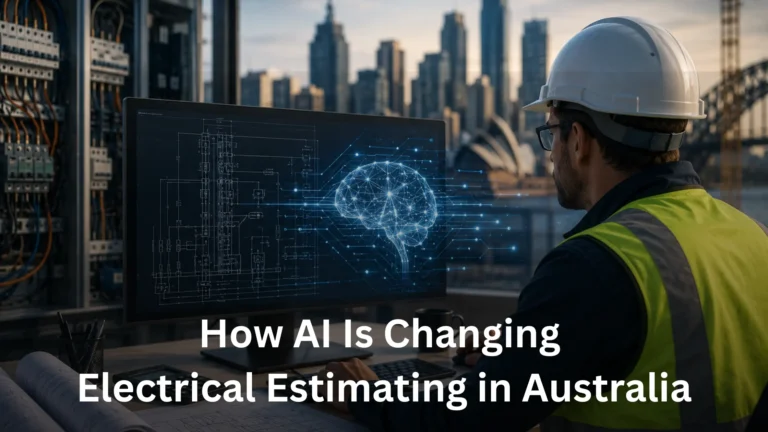
What Is AI in Electrical Estimating?
AI in electrical estimating refers to the use of artificial intelligence, machine learning, and automation technologies to assist with tasks such as quantity takeoffs, cost estimation, pricing analysis, report generation, and BIM integration.
Modern AI estimating tools can process large amounts of project data, identify patterns, and automate repetitive tasks that traditionally required significant manual effort. While AI can improve speed and consistency, experienced estimators are still required to interpret scope, assess project risks, evaluate site conditions, and make strategic pricing decisions.
Benefits of AI in Electrical Estimating
AI-assisted estimating technology offers several advantages for electrical contractors.
Faster Quantity Takeoffs
AI can automatically identify symbols, devices, and electrical components from digital drawings, significantly reducing manual counting time.
Improved Consistency
Automated workflows help reduce human counting errors and create more consistent quantity takeoffs across projects.
Faster Tender Turnaround Times
Contractors can prepare estimates and supporting documentation more quickly, allowing them to pursue more tender opportunities.
Better Access to Historical Cost Data
AI systems can analyse previous projects and provide pricing benchmarks that support early-stage budgeting and cost planning.
Reduced Administrative Work
Many AI tools can generate reports, summaries, and tender documentation automatically, freeing estimators to focus on higher-value activities.
What AI Is Currently Doing in Electrical Estimating
Automated Quantity Takeoffs
One of the most time-consuming parts of any tender is the quantity takeoff process.
AI-powered electrical estimating software can scan digital construction drawings and automatically identify and count components such as:
- Light fittings
- Power outlets
- Switchboards
- Distribution boards
- Cable runs
- Data points
Tools that use optical character recognition (OCR) and machine learning can recognise symbols, annotations, and tags, reducing manual effort while improving consistency.
For many contractors, automated quantity takeoffs represent one of the most valuable applications of AI estimating technology.
Historical Cost Data and Predictive Pricing
AI systems trained on historical project data can suggest pricing benchmarks based on:
- Project type
- Building size
- Location
- Trade scope
- Historical costs
For example, an AI system may identify average electrical installation costs for commercial office fit-outs in Brisbane or industrial facilities in Perth.
While these benchmarks can be useful reference points, they should never replace detailed project-specific estimating.
Historical Cost Data and Predictive Pricing
AI systems trained on historical project data can suggest pricing benchmarks based on:
- Project type
- Building size
- Location
- Trade scope
- Historical costs
For example, an AI system may identify average electrical installation costs for commercial office fit-outs in Brisbane or industrial facilities in Perth.
While these benchmarks can be useful reference points, they should never replace detailed project-specific estimating.
Faster Report Generation
AI tools can generate:
- Cost summaries
- Scope breakdowns
- Tender reports
- Budget estimates
- Project documentation
This can significantly reduce administrative workload for contractors managing multiple tenders simultaneously.
BIM Integration
Building Information Modelling (BIM) platforms increasingly incorporate AI capabilities that allow estimators to extract quantities directly from 3D project models.
As BIM adoption grows throughout Australia’s commercial construction sector, AI-powered BIM estimating workflows are becoming increasingly important for large and complex projects.
AI vs Human Estimators: A Comparison
| Task | AI | Human Estimator |
| Quantity Takeoffs | Excellent | Excellent |
| Report Generation | Excellent | Good |
| Historical Cost Analysis | Excellent< | Good |
| Drawing Interpretation | Limited | Strong |
| Risk Assessment | Limited | Strong |
| Site Knowledge | No | Strong |
| Supplier Negotiation | No | Strong |
| Compliance Review | Limited | Strong |
| Strategic Pricing Decisions | Limited | Strong |
| Tender Risk Management | Limited | Strong |
What AI Still Can't Do in Electrical Estimating
Despite significant advances, AI remains limited when it comes to many of the judgement-based aspects of construction estimating.
Understanding Site-Specific Conditions
AI cannot physically visit a site and assess:
- Access restrictions
- Existing infrastructure conflicts
- Working-at-height challenges
- Ceiling space limitations
- Operational constraints
Experienced estimators apply practical knowledge that goes far beyond what drawings alone can reveal.
Interpreting Ambiguous Documentation
Construction documentation is often incomplete, inconsistent, or open to interpretation.
Experienced estimators know when to:
- Seek clarification
- Identify missing information
- Make reasonable assumptions
- Include risk allowances
AI performs best with structured, high-quality data. Real-world projects rarely provide perfect information.
Negotiating Supplier and Subcontractor Pricing
- Build supplier relationships
- Negotiate discounts
- Assess supplier reliability
- Evaluate commercial terms
Managing Tender Risk
- Tight construction programs
- Scope uncertainty
- Contractual exposure
- Client payment risks
- Latent site conditions
Compliance With Australian Regulations
- Australian Standards
- AS/NZS requirements
- State-based regulations
- Project-specific specifications
Risks of Relying Too Heavily on AI
While AI estimating tools provide valuable support, overreliance can create problems.
Potential risks include:
Incorrect Quantity Recognition
AI can occasionally misidentify symbols or incorrectly interpret drawings.
Outdated Cost Data
If pricing databases are not regularly updated, AI-generated estimates may quickly become inaccurate.
Missed Scope Items
AI systems may overlook project-specific requirements that fall outside their training data.
Compliance Oversights
Automated systems may not fully account for evolving Australian electrical standards and regulations.
Lack of Project Context
AI cannot fully understand client expectations, site challenges, contractual risks, or commercial relationships.
For this reason, human oversight remains critical throughout the estimating process.
The Right Way to Think About AI in Estimating
AI should be viewed as a productivity tool—not a replacement for professional expertise.
The most successful estimating teams use AI to automate repetitive and time-consuming tasks while allowing experienced estimators to focus on:
- Scope interpretation
- Risk assessment
- Supplier engagement
- Strategic pricing
- Client requirements
- Compliance review
This combination of technology and human expertise often delivers better outcomes than either approach alone.
Practical Tips for Australian Electrical Contractors
If you’re considering AI-assisted estimating tools:
- Use AI-generated quantity takeoffs as a starting point, not a final result.
- Always have an experienced estimator review outputs.
- Treat AI pricing benchmarks as validation tools rather than final pricing.
- Review all AI-generated reports before submission.
- Invest in training if implementing new estimating software.
- Consider BIM integration for larger projects.
If technology adoption feels overwhelming, consider outsourcing estimating to specialists who already use modern estimating platforms.
FAQ: AI and Electrical Estimating
Can AI replace electrical estimators?
Not currently. AI can automate quantity takeoffs, reporting, and data analysis, but it cannot replicate the professional judgement, risk assessment, and practical experience of an experienced estimator.
What AI tools are available for electrical estimating in Australia?
Several electrical estimating software platforms now incorporate AI features, including takeoff automation, BIM integration, predictive pricing, and reporting tools. Adoption is growing rapidly across commercial and industrial construction projects.
Is AI-assisted estimating more accurate than manual estimating?
AI can reduce manual counting errors and improve consistency. However, overall accuracy still depends on project documentation quality and human review.
Will AI change the cost of electrical estimating services?
AI can reduce the time required to complete certain estimating tasks, improving efficiency and turnaround times. However, professional expertise remains essential for producing accurate estimates.
How accurate are AI quantity takeoffs?
Accuracy can be very high when drawings are clear and well-structured. However, performance can decline when documents are incomplete, inconsistent, or poorly formatted.
Conclusion
AI is changing the way electrical estimates are prepared, particularly by improving speed, consistency, and efficiency in repetitive tasks such as quantity takeoffs and report generation.
However, the fundamentals of successful estimating remain unchanged: accurate scope interpretation, realistic pricing, effective risk management, and sound professional judgement.
The contractors most likely to benefit from AI are not replacing estimators with technology—they are combining modern estimating tools with industry experience to produce faster, more accurate, and more competitive tenders.
At Estimating Solutions, we combine advanced estimating technology with practical industry expertise to help electrical contractors across Australia win more work while protecting their profit margins.
Our estimators support commercial, industrial, infrastructure, healthcare, education, and government projects, delivering accurate quantity takeoffs, cost estimates, and tender pricing tailored to Australian market conditions.
Learn more about our electrical estimating services or contact us today to discuss your next project.