Electrical Estimating Terms Explained: Guide
If you’re new to tendering, electrical estimating terms can feel like a second language. Apprentices stepping into the estimating office, and builders reading an electrical contractor’s tender, often hit the same wall: everyone uses the words as if they’re obvious. This guide is a plain-English electrical estimating glossary. It covers the terms you’ll see on most tenders, grouped by topic so you can find a definition quickly and get back to work.
A quick note before we start: some words below, such as allowances, variations and exclusions, can have a specific meaning in a particular contract. Where that’s the case, we’ll flag it. The exact meaning can depend on the contract, so check the tender documents.
Electrical Estimating Terms You’ll See on Almost Every Tender
Let’s begin with the foundations: the words that describe what is being priced and how the price is organised.
The big three, in one line each
Three terms get mixed up more than any others, so here is the short version:
- BOQ (bill of quantities): a structured list of items and quantities that tenderers price.
- Takeoff: the process of measuring and counting items from the plans and specifications. That is the basic takeoff meaning.
- Estimate: the priced outcome, where quantities, labour, materials and other costs come together.
We cover how these three differ, and when each one is used, in our full comparison of BOQ, takeoff and estimate for contractors, so we won’t repeat it here.
Scope
Scope (or scope of work) describes what the electrical contractor is expected to supply and install on the job. It might include power, lighting, data cabling, switchboards and so on. A clear scope is the starting point for an accurate price, because anything unclear becomes a risk. If you only remember one term from this guide, make it this one.
Allowances
An allowance is an amount or quantity included in a price for something that isn’t fully defined yet. For example, a builder might ask for an allowance for light fittings when the final selections haven’t been made. Estimators often use allowances to keep a tender moving when information is missing.
Because allowances can be treated differently from one contract to the next, the exact meaning can depend on the contract, so check the tender documents.
Preliminaries
Preliminaries (often shortened to “prelims” or P&G) are the general costs of running a job that aren’t tied to one particular item of electrical work. Think site supervision, site setup, travel, general tools and equipment, and administration. In an estimate, preliminaries usually sit in their own section rather than being spread through the item rates.
Different companies group these costs differently, so check how a tender defines them before comparing prices side by side.
Electrical Estimating Terms for Pricing: Rates, Markup, Margin and Contingency
This part of your estimating terminology covers how a price is built and what sits on top of the raw costs.
Rates
A rate is the cost for a unit of work or material. It might be a labour rate per hour, or an installed rate per outlet or per metre of cable. Estimators build rates from labour time, material costs and any other costs they’ve identified.
Rates only work if the quantities behind them are right, which is why the counting stage matters so much. If you want to see what good quantities look like, read what’s included in a professional electrical takeoff. Even the best rate can’t rescue a missed item.
Supplier quote
A supplier quote is a price from a supplier or wholesaler for specific materials or equipment, such as a switchboard, lighting package or cable. Estimators use supplier quotes to price items that aren’t covered by standard rates, or to check current pricing for larger orders.
A few things are worth checking on every supplier quote:
- What exactly is included (and what isn’t)
- How long the quote is valid
- Whether the quote is based on the same revision of the drawings you’re pricing
Prices change, so an old quote can quietly make a tender inaccurate.
Markup
Markup is an amount added on top of your costs to cover overheads and profit. It’s calculated as a percentage of the cost.
Margin
Margin is the profit shown as a percentage of the selling price. People often use markup and margin as if they mean the same thing, but they don’t, and the difference matters when you’re checking whether a job makes money.
Example only: if a job costs 100 units to deliver and you add a markup of 10 per cent, the selling price is 110 units. The profit is 10 units. But as a share of the selling price, that profit is a little over 9 per cent. So a 10 per cent markup gives a margin below 10 per cent.
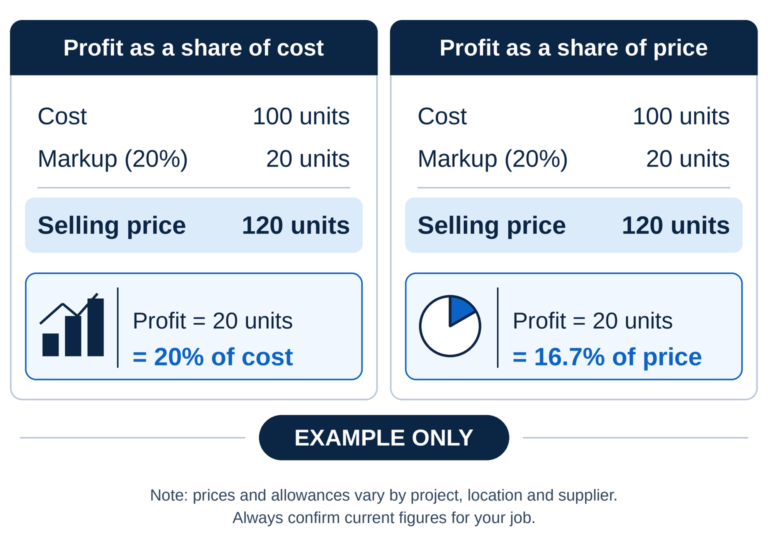
Note: prices and allowances vary by project, location and supplier. Always confirm current figures for your job.
Contingency
Contingency is an amount set aside in the estimate for risks or unknowns that are expected but can’t be pinned down yet. It might cover things like minor design changes or unexpected site conditions. Whether a contingency is shown separately or built into rates is a choice for each company, so ask if you’re not sure.
Tender Change Terms: Variations, Exclusions, Qualifications, Addenda and Revisions
This group of construction estimating terms in Australia causes the most confusion between builders and contractors. The words describe what changes, and what isn’t included, once a tender is underway.

Variations
In everyday use, a variation is a change to the work after the price has been agreed. That might mean extra outlets, a different light fitting or a revised layout. Many variations lead to a price adjustment.
However, how variations are requested, priced and approved is usually set out in the contract. The exact meaning can depend on the contract, so check the tender documents.
Exclusions
Exclusions are the things the contractor has deliberately left out of their price. A tender might exclude, for example, certain equipment supplied by others or work that falls under another trade. A good estimator lists exclusions clearly so there are no surprises later.
When you’re comparing tenders, read the exclusions carefully. Two prices that look different might simply be pricing different amounts of work. As always, the exact meaning can depend on the contract, so check the tender documents.
Qualifications
Qualifications are conditions or assumptions attached to a price. For example, a contractor might state that their price is based on a particular revision of the drawings, or that it only holds for a set period. Qualifications and exclusions are related, but a simple way to separate them is that exclusions say what’s left out, while qualifications say what the price depends on.
Since qualifications can carry weight in a contract, the exact meaning can depend on the contract, so check the tender documents.
Addenda
Addenda (one is an “addendum”) are additional documents issued during the tender period that add to or change the original information. They might include clarifications, updated drawings or answers to questions. Missing an addendum is one of the easiest ways to price the wrong job, so estimators track them carefully.
Revisions
A revision is an updated version of a drawing or document. Drawings are often labelled with revision letters or numbers so everyone can tell which version is current. Before you price anything, check that you’re working from the latest revision. If your takeoff was done on an older revision, your quantities may no longer match the job.
Common Estimating Abbreviations
Estimating abbreviations are everywhere, and they’re rarely explained. Here are some everyday ones you’ll meet on plans and tender documents:
Abbreviation | Meaning |
GPO | General power outlet (a standard power point) |
DB | Distribution board |
MSB | Main switchboard |
SWB | Switchboard |
RFI | Request for information (a question sent to the designer or builder) |
RFQ | Request for quotation |
P&G | Preliminaries and general |
TBC | To be confirmed |
QS | Quantity surveyor |
Ea | Each |
Lot | A single lump-sum item |
Abbreviations can vary between consultants and companies, so if one isn’t clear on a drawing, send an RFI instead of guessing. For general information about the electrical contracting industry, industry bodies such as the National Electrical and Communications Association (NECA) are a good place to start.
How to Use This Electrical Estimating Glossary
If you’re working through your first few tenders, here is a simple way to put these terms to use:
- Start with the scope. Know exactly what you’re pricing before you count anything.
- Check the latest revision and any addenda. Make sure the documents are current.
- Note allowances, exclusions and qualifications as you go. Don’t leave them to the end.
- Check how rates, preliminaries and markup have been applied. This helps when you compare tenders.
- Ask when you’re unsure. A quick question early is much cheaper than a mistake later.
If you’d rather hand the pricing to specialists, our electrical estimating service covers takeoffs and estimates so you can focus on winning and delivering the work.
Unsure What a Term Means on Your Tender?
Tender documents don’t always use plain language, and every company has its own habits. If you’re stuck on a term, a clause or an abbreviation, you don’t have to guess. Ask the team at Estimating Solutions and we’ll help you make sense of it.