Electrical Estimating for Data Centres
Data centres have become one of the fastest-growing sectors in Australia’s commercial construction industry. As businesses continue to adopt cloud computing, artificial intelligence, digital services, and large-scale data storage, the demand for modern, high-performance data centres continues to increase.
Unlike conventional commercial buildings, data centres require highly reliable electrical infrastructure capable of supporting continuous operation, critical IT equipment, and redundant power systems. For this reason, electrical estimating for data centres requires careful planning, detailed quantity takeoffs, and a thorough review of project documentation to prepare accurate cost estimates.
From incoming power distribution and backup generators to uninterruptible power supply (UPS) systems and specialised cooling infrastructure, every element of a data centre contributes to project complexity. Estimators must work from the approved drawings, specifications, equipment schedules, and tender documents to understand the full project scope before preparing an estimate.
While electrical engineers are responsible for system design and compliance, experienced electrical estimators use project documentation to calculate material quantities, labour requirements, and project costs that support competitive tender submissions.
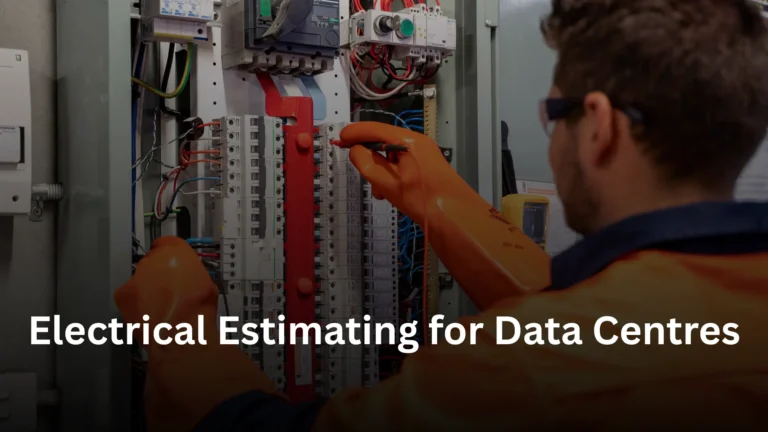
Electrical estimating for data centres is the process of preparing detailed cost estimates for facilities that support digital infrastructure. It considers critical power systems, backup power, UPS systems, communications infrastructure, and project specifications to help contractors prepare accurate tenders and plan projects effectively.
Why Data Centres Require Specialist Electrical Estimating
Data centres differ significantly from standard commercial buildings because uninterrupted electrical power is fundamental to their operation. Even short power interruptions can affect critical business services, making redundancy and reliability central to the project design.
Compared with offices, retail developments, or warehouses, data centres typically include:
- High-capacity electrical infrastructure
- Multiple incoming power supplies
- Backup generators
- UPS systems
- Battery energy storage
- Redundant switchboards
- Power distribution units (PDUs)
- Busway systems
- Advanced monitoring systems
- Building management integration
- Extensive communications cabling
Each of these systems increases the level of detail required during estimating.
Because many electrical systems work together to maintain continuous operation, missing even a small scope item can influence material quantities, labour allowances, procurement planning, and tender pricing.
Professional electrical estimating services Australia help contractors review project documentation carefully and identify these specialised requirements before tender submission.
Types of Data Centre Projects That Require Electrical Estimating
Although every project has unique requirements, electrical estimating commonly supports several types of data centre developments.
Enterprise Data Centres
Enterprise data centres are privately owned facilities built to support large organisations and corporations.
These projects often include:
- Dedicated server halls
- UPS systems
- Generator backup
- Security systems
- Communications infrastructure
- High-capacity switchboards
Because enterprise facilities are designed for long-term reliability, electrical systems are typically more extensive than those found in traditional office developments.
Colocation Data Centres
Colocation facilities provide infrastructure that multiple organisations use to house their servers and networking equipment.
Electrical estimating for these facilities may involve:
Tenant power distribution
Modular electrical infrastructure
Metering systems
Redundant power supplies
Equipment-specific electrical services
The shared nature of these facilities often requires flexible electrical infrastructure capable of supporting future tenant expansion.
Hyperscale Data Centres
Hyperscale data centres are among the largest electrical construction projects undertaken in Australia.
These facilities generally require:
- Multiple substations
- Extensive high-voltage infrastructure
- Large-scale UPS systems
- Backup generation
- Redundant electrical distribution
- Advanced monitoring systems
The scale of these developments makes detailed electrical estimating essential for accurate budgeting and resource planning.
Edge Data Centres
Edge data centres are smaller facilities positioned closer to users to reduce network latency and improve performance.
Although physically smaller than hyperscale facilities, they still require:
- Reliable backup power
- Communications infrastructure
- Cooling coordination
- Security systems
- Continuous electrical operation
Estimating these facilities requires careful review of project specifications despite their reduced size.
Key Factors That Influence Electrical Estimates for Data Centres
Data centre construction involves specialised electrical systems that directly affect project costs and estimating complexity.
Critical Power Infrastructure
Continuous power availability is one of the defining characteristics of a data centre.
Project documentation may include:
- Multiple incoming power supplies
- Main switchboards
- Distribution boards
- Power distribution units (PDUs)
- Busway systems
- Essential electrical services
These systems increase both installation complexity and material quantities, making accurate estimating particularly important.
Backup Power Systems
Most data centres incorporate backup power solutions to maintain operations during power interruptions.
Depending on the project, documentation may specify:
- Diesel generators
- Generator control systems
- Fuel system interfaces
- Automatic transfer switches
- Emergency distribution equipment
These systems contribute significantly to project costs and require detailed review during estimating.
UPS (Uninterruptible Power Supply) Systems
UPS systems provide temporary power during outages and support the transition between utility power and backup generators.
Electrical estimating may include allowances for:
- UPS equipment
- Battery systems
- Dedicated switchgear
- Monitoring equipment
- Associated cabling
- Installation labour
Although equipment selection is determined during design, understanding how these systems influence project scope helps estimators prepare more accurate cost estimates.
Cooling and Mechanical Services Coordination
Cooling systems are one of the most important components of a data centre. Unlike conventional commercial buildings, server rooms generate significant amounts of heat, making specialised cooling infrastructure essential for reliable operation.
Although mechanical engineers design these systems, electrical estimators must understand how cooling equipment affects the electrical scope.
Project documentation may include electrical requirements for:
- Computer Room Air Conditioning (CRAC) units
- Computer Room Air Handlers (CRAH)
- Chillers
- Cooling towers
- Pumps
- Ventilation equipment
- Building
- Management Systems (BMS)
- Monitoring and control equipment
Each system requires electrical connections, distribution infrastructure, controls, and coordination with other building services.
Estimators carefully review the documentation to identify these requirements and ensure associated materials and labor are included in the estimate.
High Equipment Density
Data centres contain considerably more electrical equipment than traditional commercial buildings.
A typical project may include:
- Server racks
- Power Distribution Units (PDUs)
- UPS systems
- Battery banks
- Switchboards
- Busway systems
- Communications cabinets
- Security equipment
- Environmental monitoring devices
- Fire detection systems
This high equipment density often results in:
- Larger cable quantities
- Additional containment systems
- Increased switchboard capacity
- More distribution boards
- Greater installation labour
- Higher coordination requirements
Accurate quantity takeoffs become increasingly important as equipment density increases throughout the facility.
Communications Infrastructure
Reliable communications infrastructure is fundamental to every data centre.
While specialist ICT contractors install much of the communications equipment, electrical estimators still review documentation that includes:
- Fibre optic pathways
- Structured cabling support
- Communications cabinets
- Equipment rooms
- Cable trays
- Power supplies for ICT equipment
- Monitoring systems
Coordination between electrical and communications services helps ensure the estimate reflects the complete project scope.
Redundancy and Resilience Requirements
One of the defining characteristics of modern data centres is redundancy.
Many facilities are designed so that critical systems continue operating even if a component fails.
Depending on the project, this may involve:
- Dual power feeds
- Redundant switchboards
- Multiple UPS systems
- Generator redundancy
- Duplicate cable routes
- Separate distribution pathways
- Independent monitoring systems
Although the level of redundancy varies between projects, these requirements often increase both material quantities and installation complexity.
Carefully reviewing project specifications helps estimators understand where additional infrastructure has been incorporated into the design.
Future Expansion Capacity
Many data centres are constructed with future growth in mind.
Project documentation may include allowances for:
- Spare switchboard capacity
- Additional cable pathways
- Future server halls
- Expansion-ready busway systems
- Additional UPS capacity
- Spare communications infrastructure
These provisions may not be fully utilised during the initial construction phase, but they often form part of the electrical installation and should be considered during estimating.
Recognising future expansion requirements allows contractors to prepare estimates that better reflect the intended project scope.
Common Estimating Challenges in Data Centre Construction
Data centre projects are often characterised by complex documentation, evolving technology, and demanding construction programmes.
Some of the most common estimating challenges include:
Incomplete Design Information
Large infrastructure projects sometimes progress through multiple design stages before construction begins.
During tendering, estimators may encounter:
- Preliminary drawings
- Equipment schedules awaiting confirmation
- Ongoing consultant coordination
- Design clarifications
Where project information is incomplete, assumptions should be clearly identified and clarified wherever possible.
Equipment Revisions
Technology changes rapidly within the data centre industry.
Server infrastructure, UPS systems, monitoring equipment, or communications layouts may be updated during design development, requiring revisions to the estimate.
Reviewing the latest project documentation helps ensure pricing reflects the current scope.
Coordination Across Multiple Disciplines
Data centre projects require close collaboration between:
- Electrical engineers
- Mechanical engineers
- ICT consultants
- Security consultants
- Fire protection designers
- Structural engineers
- Architects
- Equipment suppliers
Electrical estimators review information from multiple disciplines to ensure all relevant electrical work is captured within the estimate.
Complex Specifications
Data centre specifications are often extensive and highly detailed.
They may include:
- Performance requirements
- Critical power infrastructure
- Redundancy requirements
- Testing and commissioning procedures
- Documentation and handover requirements
- Integration with multiple building systems
These requirements can significantly influence labour allowances and project costs.
Tight Tender Programmes
Many data centre developments operate under demanding procurement schedules.
Contractors are often required to prepare comprehensive tenders within limited timeframes while maintaining pricing accuracy.
Efficient estimating workflows help support timely tender submissions without compromising estimate quality.
Why Accurate Electrical Takeoffs Are Critical
Comprehensive electrical takeoffs form the foundation of every successful data centre estimate.
Because these facilities contain thousands of electrical components, detailed quantity measurement is essential for preparing accurate material and labour calculations.
Electrical takeoffs commonly include:
- Power cabling
- Busway systems
- Cable containment
- Switchboards
- Distribution boards
- Power Distribution Units (PDUs)
- UPS equipment
- Generator connections
- Communications infrastructure
- Lighting systems
- Earthing systems
- Equipment supports
Accurate takeoffs provide contractors with clearer visibility of project costs while supporting:
- Material procurement
- Labour planning
- Project scheduling
- Tender pricing
- Resource allocation
Careful quantity measurement also reduces the likelihood of omissions that may affect profitability during construction.
Best Practices for Estimating Data Centre Projects
Data centre estimating requires a structured approach supported by detailed project review.
Experienced estimators typically follow practices such as:
✔ Review every drawing package before beginning quantity takeoffs.
✔ Coordinate electrical documentation with mechanical, ICT, fire protection, and architectural drawings.
✔ Review equipment schedules carefully to identify project-specific electrical requirements.
✔ Confirm the latest project revisions before preparing the estimate.
✔ Clearly document assumptions where project information is incomplete.
✔ Consider future expansion allowances included within the design documentation.
✔ Conduct internal quality reviews before issuing completed estimates.
By following these best practices, contractors can improve estimate reliability, reduce pricing risk, and prepare more competitive tenders for complex data centre developments across Australia.
Benefits of Using Professional Electrical Estimating Services
Data centre construction projects require exceptional attention to detail. With critical power systems, extensive communications infrastructure, and multiple building services working together, accurate estimating plays an important role in helping contractors prepare competitive tenders and manage project risk.
Professional electrical estimating services provide the expertise and structured workflows needed to prepare reliable estimates for complex data centre developments across Australia.
More Accurate Pricing
Experienced estimators carefully review electrical drawings, specifications, equipment schedules, and tender documentation to produce detailed cost estimates that align with the project’s intended scope.
This thorough approach helps minimise pricing omissions while providing contractors with greater confidence during bid preparation.
Reduced Tender Risk
Data centre projects often involve multiple consultants, specialist suppliers, phased construction, and evolving design documentation.
Professional estimating helps identify project requirements early, allowing contractors to reduce uncertainty and submit more informed tenders.
Better Resource Planning
Detailed estimates help contractors plan project delivery more effectively by supporting:
- Labour forecasting
- Procurement planning
- Equipment scheduling
- Cash flow management
- Resource allocation
Improved planning contributes to smoother project execution once construction begins.
Greater Confidence During Bid Preparation
Comprehensive cost breakdowns and accurate quantity takeoffs enable contractors to review pricing assumptions, respond to client queries, and evaluate design revisions before submitting tenders.
This transparency supports better decision-making throughout the tender process.
Improved Tender Efficiency
Preparing detailed data centre estimates internally can place considerable pressure on estimating teams, especially when managing multiple tender opportunities simultaneously.
Outsourcing or supplementing internal estimating resources allows contractors to maintain estimate quality while meeting demanding submission deadlines.
Support for Complex Projects
Preparing detailed data centre estimates internally can place considerable pressure on estimating teams, especially when managing multiple tender opportunities simultaneously.
Outsourcing or supplementing internal estimating resources allows contractors to maintain estimate quality while meeting demanding submission deadlines.
How Our Electrical Estimating Team Supports Data Centre Projects
Our experienced estimating team provides Australia-wide support for contractors delivering data centre and other complex commercial developments.
We assist with projects including:
- Enterprise data centres
- Colocation facilities
- Hyperscale data centres
- Edge data centres
- Communications infrastructure upgrades
- Critical power installations
Our estimating services include:
- Detailed electrical takeoffs
- Material quantity calculations
- Labour cost estimation
- Tender preparation
- Cost planning support
- Scope reviews
- Professional estimating reports
Every estimate is prepared using the latest project drawings, specifications, schedules, and tender documentation supplied by the client.
Rather than relying on assumptions or previous project pricing, we review each project individually to produce estimates that reflect the documented project scope.
Whether you’re pricing a new hyperscale facility or expanding an existing enterprise data centre, our experienced estimating team provides reliable support that helps contractors prepare competitive tenders with confidence.
Conclusion
Data centres are among the most technically demanding construction projects in today’s market. Their dependence on continuous power, redundant electrical systems, advanced communications infrastructure, and multidisciplinary coordination makes accurate estimating essential throughout the tender process.
From critical power distribution and UPS systems to generator infrastructure and future expansion allowances, every aspect of a data centre project can influence material quantities, labour requirements, and overall project costs.
Preparing detailed electrical estimates based on complete project documentation helps contractors improve planning, reduce pricing risk, and submit competitive tenders with greater confidence.
Working with an experienced electrical estimating team provides additional support when pricing complex projects while allowing contractors to focus on delivering high-quality construction outcomes.
Planning a new data centre or critical infrastructure project? Contact our experienced electrical estimating team today for detailed, reliable estimating support tailored to your project requirements anywhere in Australia.
Frequently Asked Questions
Why is electrical estimating for data centres more complex than standard commercial buildings?
Data centres require specialised electrical systems such as redundant power supplies, UPS systems, backup generators, communications infrastructure, and advanced monitoring systems. These additional systems increase project complexity and require detailed estimating based on comprehensive project documentation.
What electrical systems are commonly included in a data centre?
Depending on the project, data centres may include:
- Main switchboards
- Distribution boards
- UPS systems
- Backup generators
- Busway systems
- Power Distribution Units (PDUs)
- Battery storage systems
- Communications infrastructure
- Environmental monitoring systems
- Fire detection systems
- Building management systems
The specific electrical scope depends on the project’s drawings and specifications.
How do UPS systems affect electrical estimating?
UPS systems introduce additional equipment, switchgear, battery systems, monitoring infrastructure, cabling, and installation labour. These requirements increase both material quantities and project complexity, making accurate estimating particularly important.
What information is needed before preparing a data centre electrical estimate?
Professional estimators generally require:
- Electrical drawings
- Architectural drawings
- Equipment schedules
- Project specifications
- Scope of works
- Tender documentation
- Addenda and revisions
- Supporting consultant documentation
Complete and up-to-date project information enables more accurate cost estimates.
Can electrical estimating services support large-scale data centre tenders?
Yes. Professional electrical estimating services assist contractors by preparing detailed takeoffs, labour calculations, material quantities, and tender cost breakdowns for enterprise, colocation, hyperscale, and edge data centre developments.
How long does a data centre electrical estimate usually take?
The timeframe depends on project size, documentation quality, design complexity, and the level of detail required. Smaller edge data centres may require less estimating time than large hyperscale facilities. After reviewing the documentation, an estimating team can provide an expected turnaround timeframe.