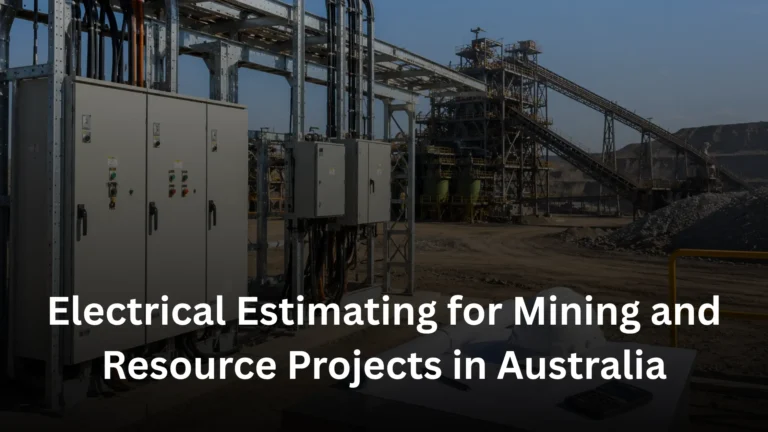
Electrical Estimating for Mining and Resource Projects in Australia
Mining electrical estimating in Australia is the process of identifying, measuring and pricing the electrical work required for mining, minerals processing and resource projects. A comprehensive estimate can cover power distribution, switchboards, transformers, industrial lighting, cabling, containment, equipment connections, labour, logistics and site-specific requirements.
Mining projects can be significantly more complex than conventional commercial construction because electrical installations may need to be delivered across large sites, remote locations and demanding operating environments. Accurate estimating therefore requires careful review of drawings, specifications, project scope, access conditions and construction requirements.
For electrical contractors, subcontractors and builders preparing major tenders, a structured mining electrical takeoff can provide a clearer basis for understanding quantities, labour and project costs before submission.
Why is electrical estimating important for mining projects?
Mining and resource projects can involve extensive electrical infrastructure distributed across processing areas, workshops, accommodation facilities, administration buildings, utilities and other site assets.
The estimate may need to account for:
- High-voltage or medium-voltage distribution where specified
- Transformers and switchgear
- Main and distribution switchboards
- Industrial lighting
- Power and control cabling
- Cable tray and ladder
- Equipment connections
- Earthing and bonding
- Communications and control interfaces
- Installation labour
- Site access and logistics
- Testing and commissioning
The exact scope depends on the project design and tender documents. Estimators should avoid applying generic allowances where project-specific information is available.
What should be included in a mining electrical takeoff?
A detailed mining electrical takeoff should cover the complete electrical scope and connect quantities to the project’s drawings and specifications.
Estimating Area | Items to Review |
Power distribution | Transformers, switchboards, distribution equipment and feeders |
Lighting | Internal, external, industrial and area lighting |
Cabling | Power, control, communications and earthing cables |
Containment | Cable tray, ladder, conduit, trunking and supports |
Equipment | Motors, plant connections and electrical equipment interfaces |
Site infrastructure | Workshops, offices, utilities and other facilities |
Labour | Installation, termination, testing and commissioning |
Logistics | Site access, transport, mobilisation and material handling where applicable |
The estimator should also identify interfaces with mechanical, civil, structural, instrumentation and process systems.
1. Power distribution and switchgear
Power distribution is a major component of resource project estimating.
Review project documentation for:
- Incoming supplies
- Transformers
- Main switchboards
- Distribution boards
- Motor control equipment
- Switchgear
- Protective devices
- Feeders
- Submains
- Equipment connections
- Metering and monitoring equipment
Single-line diagrams can be particularly important because they provide information about the relationship between major distribution equipment that may not be apparent from individual layouts.
For larger projects, quantities should be organised by area, voltage level, equipment type or other project-specific categories where appropriate.
2. Industrial and site lighting
Mining facilities can contain a wide range of lighting requirements across operational and support areas.
Review for:
- Internal lighting
- External lighting
- High-bay or industrial fittings where specified
- Access and circulation lighting
- Area lighting
- Emergency lighting where included
- Lighting controls
- Sensors and associated devices
- External poles and mounting arrangements where applicable
Lighting quantities should be checked against schedules as well as plans. Site-wide lighting can involve extensive cabling and support infrastructure, so fixture counts alone do not represent the complete scope.
3. Cabling and cable containment
Cabling is another major component of industrial electrical estimating in Australia.
Depending on the project, review:
- Power cables
- Submains
- Control cables
- Instrumentation interfaces where included in scope
- Communications cabling
- Earthing conductors
- Cable tray
- Cable ladder
- Conduit
- Trunking
- Supports and brackets
- Cable glands and terminations
Mining sites can have long cable routes between distribution equipment and remote loads. Estimators should use available route information rather than relying on generic distances.
Where routes are not fully defined, assumptions should be clearly documented.
4. Equipment and plant connections
Resource projects often include electrical connections to plant and equipment supplied by different contractors or vendors.
Review documentation for:
- Motors
- Pumps
- Fans
- Conveyors
- Processing equipment
- Workshop equipment
- HVAC systems
- Mechanical plant
- Specialist equipment
- Control panels
The estimator should establish whether the electrical contractor is responsible for the complete connection, cabling only, termination, containment or another defined portion of the scope.
This is where coordination between electrical and mechanical documentation becomes particularly important.
Remote-site factors affecting mining project cost estimating
Remote locations can introduce estimating considerations that are less significant on typical metropolitan construction projects.
Depending on the project, review:
- Site access
- Travel requirements
- Accommodation arrangements
- Mobilisation and demobilisation
- Material transport
- Equipment delivery
- Site storage
- Workforce availability
- Work sequencing
- Site establishment requirements
- Weather or environmental constraints where documented
- Access to specialist services
These factors can affect the labour and logistics components of an estimate.
They should not be treated as generic percentages without supporting project information. Instead, the estimator should identify documented requirements and clearly state assumptions where information is unavailable.
Labour considerations for mining electrical projects
Mining electrical estimating needs to consider how the work will actually be installed.
Labour requirements can be influenced by:
- Site location
- Access to work areas
- Cable route lengths
- Equipment size
- Installation heights
- Containment complexity
- Termination requirements
- Shutdown or staged work requirements
- Coordination with other contractors
- Testing and commissioning
- Project sequencing
For a large tender, labour should be assessed alongside the quantity takeoff rather than added as an afterthought.
What are the main risks in mining electrical estimating?
Mining and resource projects can present several estimating risks.
Incomplete documentation
Missing drawings, unclear specifications or unresolved interfaces can make it difficult to establish the complete electrical scope.
Long cable routes
Large sites can require substantial quantities of power and control cabling. Underestimating routes can materially affect the tender.
Scope interfaces
Electrical work can intersect with civil, mechanical, process, instrumentation and structural packages. Unclear responsibilities can create omissions or duplicated allowances.
Remote logistics
Transport, mobilisation and material handling may require additional planning where project documentation identifies remote or difficult site conditions.
Design revisions
Changes to plant layouts, equipment selections or distribution arrangements can affect previously measured quantities.
Testing and commissioning
The tender should clearly identify responsibilities for testing, commissioning, documentation and handover.
A structured review process can help contractors identify these risks before tender submission.
How to estimate a mining electrical project
A consistent workflow can make complex tenders easier to manage.
Step 1: Gather the latest documentation
Collect electrical drawings, single-line diagrams, specifications, equipment schedules and relevant civil, mechanical and process documentation.
Step 2: Establish the scope
Determine what is included, excluded, client-supplied or allocated to another contractor.
Step 3: Divide the project into areas
Organise the takeoff by plant area, building, infrastructure package or another logical project structure.
Step 4: Complete the electrical quantity takeoff
Measure distribution equipment, lighting, cabling, containment, equipment connections and associated electrical components.
Step 5: Assess labour and logistics
Review installation complexity, site access, mobilisation, transport and project sequencing based on available information.
Step 6: Cross-check interfaces
Compare electrical quantities against mechanical, civil, structural and equipment documentation.
Step 7: Record assumptions and exclusions
Clearly document unresolved information, scope boundaries and estimating assumptions.
Step 8: Complete a tender review
Check quantities, revisions, labour, logistics, exclusions and project requirements before submission.
For additional background on estimating complex industrial work, see this guide to electrical estimating for industrial projects.
When should contractors outsource mining electrical estimating?
Complex mining tenders can require substantial estimating resources, particularly when documentation includes multiple disciplines, large quantities and strict tender deadlines.
Professional estimating support may be useful when:
- Internal estimators are managing several tenders
- A large mining project requires extensive takeoffs
- The project is located remotely
- Electrical documentation is highly detailed
- Multiple work packages need to be reviewed
- Additional estimating capacity is required for a major tender
If your team is preparing a mining or resource-sector tender, explore professional electrical estimating services to discuss the project’s drawings, scope and estimating requirements.
Providing complete documentation and the tender deadline at the outset can help establish the appropriate level of estimating support.
Mining Electrical Estimating Checklist
Before finalising a mining electrical tender, check:
- Latest electrical drawings and revisions
- Single-line diagrams
- Project specifications
- Main switchboards and distribution equipment
- Transformers and switchgear where applicable
- Industrial and external lighting
- Power cabling and submains
- Control and communications cabling
- Cable tray, ladder and conduit
- Cable supports and accessories
- Equipment and plant connections
- Earthing and bonding
- Labour requirements
- Remote-site access requirements
- Mobilisation and demobilisation
- Material transport and logistics
- Testing and commissioning
- Cross-discipline interfaces
- Assumptions and exclusions
- Drawing revisions and scope changes
This checklist provides a practical framework, but project-specific drawings and specifications should always determine the final scope.
Supporting complex mining and resource tenders
Mining electrical estimating requires more than measuring electrical components from plans. Contractors need to understand how power distribution, industrial lighting, cabling, containment, plant connections, labour and site logistics combine to form the complete project scope.
A structured takeoff can make large tender packages easier to review and help identify potential omissions before pricing is finalised.
If your business is preparing a complex mining, minerals processing or resource-sector tender, discussing the project early with an estimating professional can help establish the required scope and workload.
For a project-specific discussion, talk to Estimating Solutions Group about your mining electrical estimating requirements.
Frequently Asked Questions
What is mining electrical estimating?
Mining electrical estimating is the process of measuring and pricing electrical work associated with mining and resource projects. It can include power distribution, lighting, cabling, containment, equipment connections, labour, logistics and commissioning.
What is included in a mining electrical takeoff?
A mining electrical takeoff can include switchboards, transformers, switchgear, lighting, power and control cabling, containment, equipment connections, earthing and other electrical components defined by the project scope.
Why is mining electrical estimating different from commercial estimating?
Mining projects can involve larger sites, remote locations, industrial equipment, extensive cable routes, complex distribution systems and additional logistics. These factors can make the estimating process more involved than standard commercial projects.
What affects mining project cost estimating?
Project size, electrical system complexity, cable routes, equipment quantities, labour requirements, site access, mobilisation, logistics, project sequencing, testing and documentation can all affect the final estimate.
How do remote locations affect electrical estimating?
Remote projects may require additional consideration of mobilisation, accommodation, transport, material delivery, site access and workforce logistics. The exact requirements should be established from project documentation rather than assumed.
What are common risks in mining electrical estimating?
Common risks include incomplete documentation, long cable routes, unclear trade interfaces, design revisions, remote-site logistics, underestimated labour and overlooked testing or commissioning requirements.
When should mining contractors outsource electrical estimating?
Outsourcing may be useful when internal estimating resources are limited, a major tender requires extensive quantity takeoffs or several complex projects need to be priced simultaneously.
Final Takeaway
Mining electrical estimating in Australia requires a detailed understanding of the complete project environment. Power distribution, industrial lighting, cabling, containment, plant connections, labour and remote-site logistics can all influence the scope and tender price.
A structured mining electrical takeoff helps contractors organise quantities, review project interfaces and identify assumptions before submitting a major tender. For large mining and resource projects, this level of preparation can be particularly valuable when documentation spans multiple disciplines and work areas.
If you have a mining, resources or industrial electrical tender ready for review, contact Estimating Solutions Group to discuss your project and estimating requirements.